In today’s 925 English video lesson, we’re going to learn how to make generalizations in English.
Don’t you hate it when people say things like “Americans are rude?” I mean, not all Americans are rude. And people in other countries are rude too. It’s simply not helpful to say something is true of a whole group of people. When it’s negative like that, it feels wrong.
But it can be helpful to describe a group of people, as long as we are clear that it’s not everyone we’re talking about. We call this a “generalization.” For example, “many of my friends work in finance.” I’m making a generalization about my friends. And it doesn’t have to be people. If I say “most of our online sales come from Europe,” I’m generalizing about sales.
925 English video lessons for beginners (CEFR level A2). With 925 English videos you can learn business English phrases for work.
We all know that money’s not the only workplace incentive, but it sure is an effective one. Nothing beats a nice cheque at the end of the year to say “thanks for all the hard work.” That bonus can help us enjoy the holiday season more, and feel better about heading back to the office when the holiday is over.
So, how can you make sure you get that bonus? Or how can you increase the size of your bonus? Well, first of all, if you just started thinking about this now, you might be out of luck. You can’t just suck up to your boss in December and expect to be rewarded. If you’re looking for an easy workaround to hard work, I’m sorry to disappoint you.
And if you think that you deserve a bonus because you showed up on time every day and never ducked out early, then think again. If you make hamburgers at McDonalds, then your employer pays you for your time, in the form of a wage. But in professional settings, where people earn salaries, it’s not your time that your employer pays for. It’s your value.
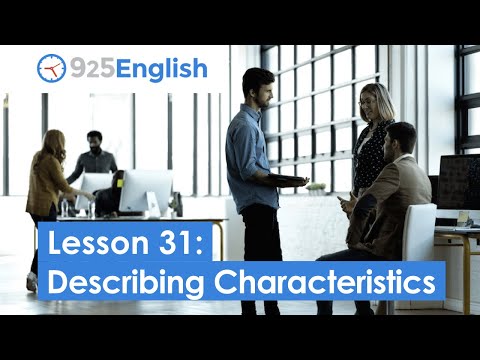
In today’s 925 English video lesson, we’re going to learn how to describe people and their characteristics in English.
Listen in on any English office conversation or meeting and you’ll hear a lot of talk about people. Who we like, who we don’t like, who’s right for a team, who should get a promotion, who is going on vacation – the list of topics goes on and on.
And one aspect of people we often discuss is their appearance, or how they look. To do that, we use adjectives, like “tall” or “short” or “well-dressed” or “heavy” or “thin.” When we describe people, we also talk about the color of their hair. And here’s a couple of special hair words for you: “brunette” means someone with brown hair, and “blonde” refers to someone with light hair or yellow hair.
925 English video lessons for beginners (CEFR level A2). With 925 English lessons you can learn English phrases and expressions for business and work.
In today’s 925 English video lesson, we’re going to learn how to talk about times and dates in English.
If you’re like most people in business, every day is scheduled down to the minute. We’ve all got meetings, timelines, tasks, and deadlines to worry about. And it seems like our phones are constantly buzzing with calendar notifications.
To keep these complex schedules up to date, we often have to ask people when something is going to happen. An easy way to do that is with the word “when,” like “when is the meeting?” That could mean either the date – or calendar day – or the time. So if you need to be more specific, you might ask “at what time is the meeting?” Or “what’s the date for the meeting?”
925 English is a course of English video lessons for beginners (CEFR level A2). With 925 English videos you can learn business English expressions and phrases to use at work.
Welcome back to Business English Skills 360 for today’s lesson on the top 10 business English skills.
In our last lesson, I focused on small talk and English conversation skills such as expressing opinions, asking questions, rejecting ideas, and getting action. Of course, conversation is what comes to mind when someone talks about language skills. But a lot of our English communication is not conversation, per se. Your skill set has to include a lot more than expressing opinions, agreeing, disagreeing, and making small talk.
Imagine for a second that you’re delivering a presentation in English or conducting a training session. What kind of skills do you need in those situations? Well, one thing you need to master is talking about how something happens or how something is done. By that I mean describing a process or giving instructions.
The key skill here is what we call sequencing, or putting your ideas in a logical order and making that order clear to your audience. To do this, you might use simple words like first, second, third, next, and finally. But you might also use expressions like “at this point, meanwhile, and subsequently. Using this kind of language helps you organize your ideas, and you’ll be less likely to lose your audience.
Connecting words aren’t limited to processes and instructions. Adept English speakers will use all sorts of words to connect their ideas and structure a good argument. Think about proposing an idea to your boss. Will you rattle on and hope he picks up the thread of what you’re trying to say? Or will you present a cohesive and persuasive argument using expressions like because of this, therefore, nevertheless, and furthermore?
Now I am not suggesting that you pepper your speech with these kinds of words just to sound intelligent. There’s a time and place for these formal expressions. But the importance of organizing your ideas holds true in any situation. And in more casual circumstances, you can simply rely more on simpler words like and, but, and so.
Besides presentations or training, another important situation with a special skill set is bargaining, or negotiating in English. And I’m not just talking about high-level talks on corporate partnerships or negotiating a major business deal. Any situation that involves give and take, cooperation, or compromise involves a kind of bargaining.
Maybe you and a colleague are trying to design a website together. Or you and your boss are trying to figure out a work schedule. Or you are trying to get two of your employees to agree on a project budget. These are all situations that demand bargaining skills. You need to acknowledge both sides and propose trade-offs. Often this requires you to make conditional sentences, using words like if, unless, and as long as. And if those statements are hypothetical, you’ll have to make sure you get a handle on important helping verbs like would and could.
I’ve talked a lot today about organizing your ideas, and about situations that require clarity of information. This brings me to another essential skill: summarizing. What happens after you’ve presented a clear and logical argument, or you’ve negotiated a compromise in a meeting? Well, you need to ensure everyone can latch on to the main ideas. That’s when you summarize.
You might hear a summary introduced with expressions like to sum up, or let’s recap briefly. But the real skill is figuring out what those main ideas or points are and then stating them concisely. You can’t repeat everything that was said verbatim. You need to distill only what is essential and paraphrase ideas appropriately.
Now before I do exactly that with my own ideas for this lesson, I’ve got one more essential but challenging skill for you: speaking clearly. You probably know some people who seem to just have a knack for clear speech. But it’s not just innate talent. You can learn to sound clear too, if you put in the time and effort.
So practice correct pronunciation. Try to enunciate clearly, even when it doesn’t feel natural for your mouth to make certain shapes or sounds. It gets easier with practice. But if you mumble, or don’t make the effort to try to produce the right sounds and intonation, then it doesn’t matter what you say, because people won’t be able to understand you.
Now how about that summary? I’ve covered five essential skills for every ace English speaker. First, there’s the ability to present a sequence or step-by-step instructions. Next is the skill of connecting your ideas logically. Then there’s bargaining and summarizing. And finally, you need to work on your pronunciation and intonation.